Advanced Solution for Power Electronics Simulation
The ultra-fast simulation platform for power electronics, delivering speeds hundreds to thousands of times faster than traditional tools. Powered by its unique Discrete-State Event-Driven (DSED) technology, DSIM effortlessly handles complex switching and multi-scale systems—enabling analyses that were once impractical, and dramatically accelerating development while cutting costs.
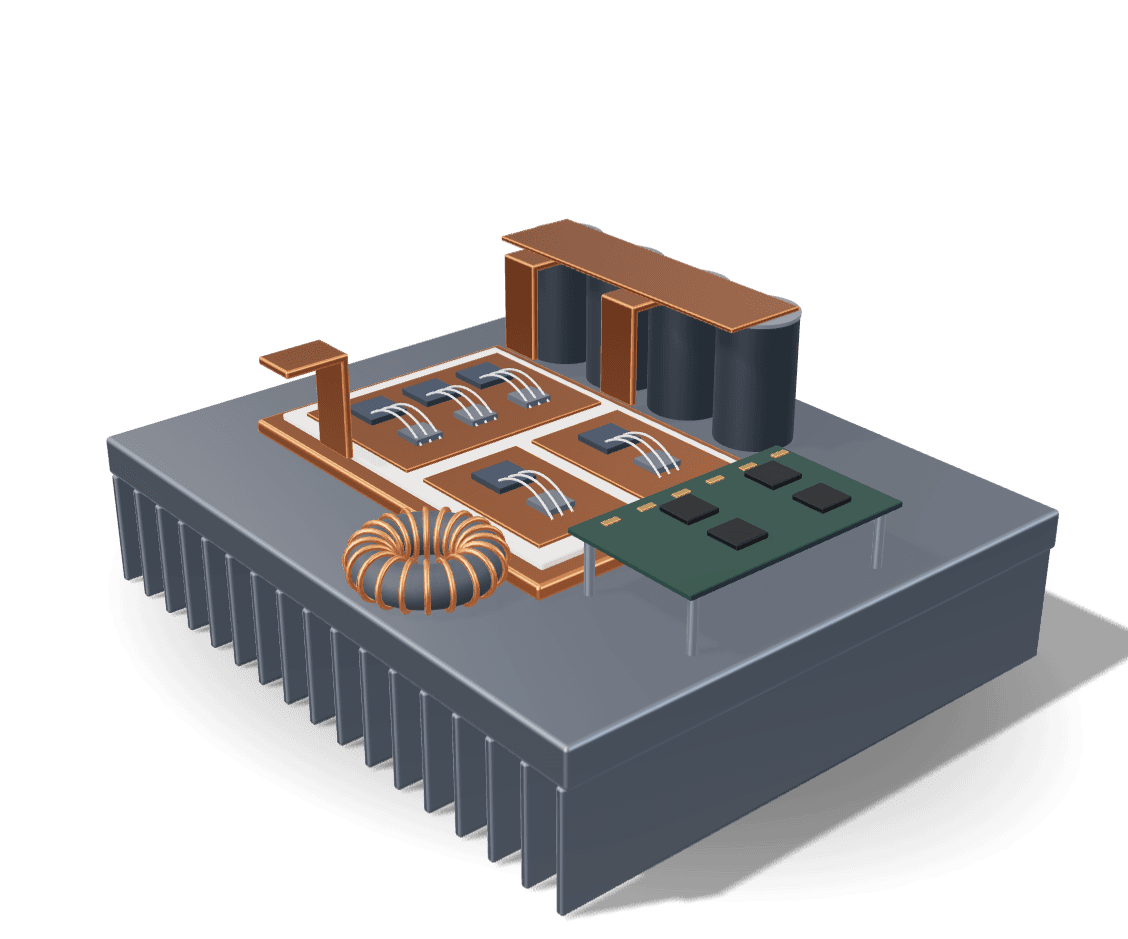
Illustrative 3D model of a half-bridge power stage. Not to scale. Labels use DSIM component library categories.
- Designed for Major Speed Gains
- Fast
- Element Library
- 350+
- DSED Architecture
- Efficient
- Excellent Convergence Behavior
- ✓
- ELECTRIC VEHICLES
- RENEWABLES
- MOTOR DRIVES
- AEROSPACE
- POWER SYSTEMS
- DATA CENTERS
- INDUSTRIAL POWER
Performance
without Compromise.
DSIM’s DSED approach is designed to deliver major speed improvements over commercially available solvers — without sacrificing the accuracy required for high-frequency switching analysis.
- Switching Transient Simulations
- Electro-Thermal Coupling
- Scales to Hundreds of Switches
DSIM’s DSED approach computes only at switching transitions, allowing DSIM to run much faster while maintaining high accuracy.
- Fixed time-step
- Conventional simulators step through time at uniform intervals, computing at every step regardless of whether a switching event occurs.
- DSED
- Computes only at switching transitions, skipping fixed time-step intervals
Drawing of where each method computes. Not to scale and not a simulation result.
DSIM Simulation Speed
Internal benchmarks comparing DSIM's DSED solver to commercially available simulation methods on identical hardware. Actual performance varies based on topology complexity and system configuration.
AUV internal benchmarks. Actual performance varies by topology and hardware configuration. These results compare DSIM against commercially available solvers, not against any specific named product.
Bar lengths are to scale within each benchmark.
Model. Simulate. Analyze.
From topology design to performance validation in three steps.
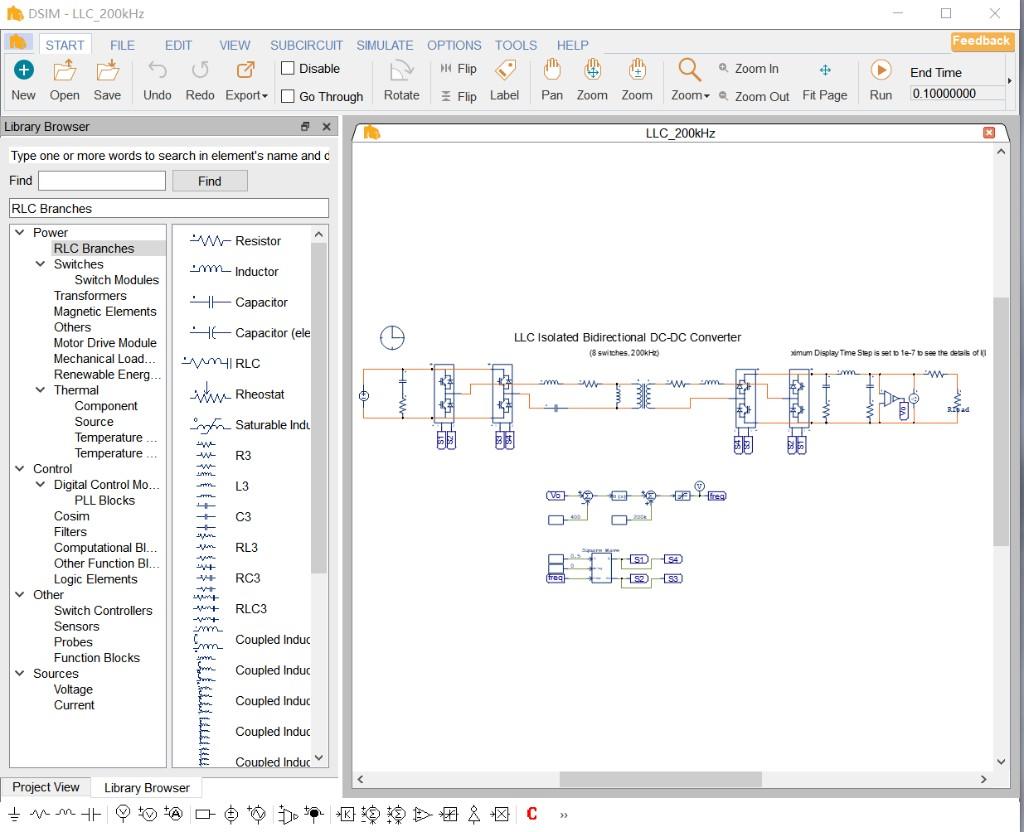
Drawing of where each method computes. Not to scale and not a simulation result.
 DSIM • Waveform AnalyzerRUNNINGIllustrative
- V_out
- 48.2V
- I_sw
- 12.7A
- T_junc
- 85.3°C
- P_loss
- 3.14W
Beyond System Simulation —
Down to Every Switching Transient
DSIM uses innovative Piecewise Analytical Transient (PAT) models that decouple the key switching characteristics of semiconductor devices from first principles.
Nanosecond Resolution, System-Level Simulation
PAT models efficiently solve turn-on and turn-off processes for IGBTs, SiC MOSFETs, and more — extending time resolution down to nanoseconds even in large system simulations.
Multi-Timescale Unified Modeling
Device-level PAT models build into system-level models with conditional timescale decoupling, significantly reducing numerical stiffness and ensuring fast, convergent simulation.
100+ Built-in Device Models
Covering hundreds of mainstream IGBT and SiC MOSFET devices, ready to use out of the box.
Direct Thermal-Electric Coupling
Switching transient results directly feed loss calculations and thermal dissipation simulation — evaluate junction temperatures and system thermal topology in real time.
Vertical Specializations
Tailored solvers and component libraries for power electronic systems.

Data Centers
Next-Gen SST Architecture. Ultra-high-efficiency voltage regulator modules, UPS systems, and multi-stage SST stability analysis.
View Details
Electric Vehicles
Traction inverters, on-board chargers, and BMS designs with physical SiC device models.
Explore EV Solutions
Renewables & Grid
Grid-tied inverter stability, MPPT algorithms, and certification-ready analysis.
View Details
Aerospace
Fault-tolerant power conversion systems validated across extreme operating conditions.
Learn MoreWhy DSIM Is Different
See how DSIM’s DSED approach compares to commercially available simulation methods.
| Capability | DSIM | Conventional Tools |
|---|---|---|
| DSED Solver | ✓ | — |
| Physical Switch Models | ✓ | Varies |
| Strong Convergence | ✓ | Common issue |
| Scales to 100s of Switches | ✓ | Often impractical |
| Electro-Thermal Coupling | ✓ | Varies |
“Conventional Tools” refers to typical commercially available simulation approaches. Actual capabilities vary by vendor.
Designed to Accelerate Your Entire Design Workflow
DSIM’s DSED approach can dramatically reduce simulation time for switched power electronic circuits — enabling more design iterations, deeper parametric analysis, and faster time-to-market for products in EV, renewables, aerospace, and industrial power.
Stay ahead in power electronics
Bi-weekly insights on simulation, design, and industry trends.
Ready to simulate at the speed of innovation?
Join the engineering teams already designing faster with AUV.